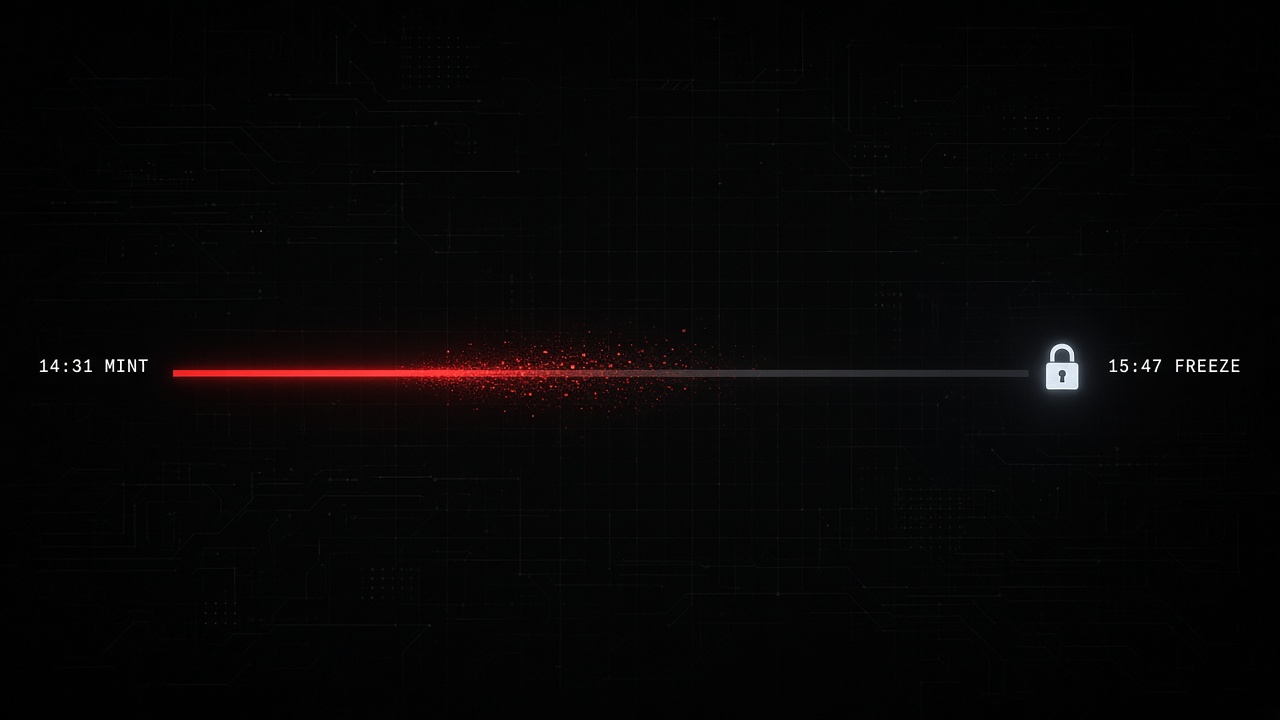
On October 17, an attacker minted 10 million CYS on BNB Smart Chain through Cysic's cross-chain bridge, with nothing locked on the other side. Cysic blacklisted the receiving address 76 minutes later. By then 7.2 million CYS had been sold and the proceeds were on Ethereum as roughly 306.6 ETH, about $727K. Seventy-six minutes is not a slow response, yet it froze only 28 percent of the mint. This breakdown looks at why.
What happened
According to the Cysic Foundation's preliminary incident report, published on October 18, the attacker gained unauthorized access to a database used by services supporting the bridge, then exploited a flaw in the processing logic to submit a fraudulent mint message. Nothing in that account points to a broken token contract. The mint path accepted a message from a compromised off-chain pipeline that was not tied to a real deposit.
Cysic suspended the bridge and says its mainnet and existing user assets were not affected. ExVul, listed in Cysic's documentation as the auditor of its bridge smart contracts, has joined the investigation. A contract audit does not cover the database behind it, which is where this attack started. As of October 20, there is no follow-up report, no confirmed root cause and no official dollar loss.
The timeline, Warsaw time
All times are CEST on October 17, based on Cysic's report and on-chain records reviewed by The Block.
14:31. The forged mint lands, sending 10 million CYS to a single address on BNB Chain.
14:36 to 14:41. The address sells 5.65 million CYS in 11 transactions for 588,315 USDT, mostly routed through OKX's DEX aggregator.
14:44 to 14:53. The USDT leaves BNB Chain. 100,000 goes through SWFT's Bridgers and the remaining 488,315 through Mayan, in six transfers.
14:57 to 14:59. A second round sells 1.55 million CYS for about 220 BNB. After this, no more CYS leaves the address.
15:05 to 15:06. The BNB is bridged through Mayan and deBridge. The last ETH payout arrives at 15:06, 35 minutes after the mint.
15:11. 306.52 ETH is moved to a second wallet that was first funded about two hours before the mint.
15:47. Cysic blacklists the address in the CYS token contract, freezing 2.8 million CYS.
Where the 76 minutes went
The attacker needed 28 minutes to sell. Every CYS that was going to leave had left by 14:59, and the cash-out to Ethereum was complete seven minutes later. The blacklist came 48 minutes after the last token moved, and a CYS blacklist on BNB Chain cannot touch ETH on Ethereum.
The pre-funded second wallet suggests the exit was planned in advance. A rehearsed exit takes minutes. A response that depends on someone noticing, confirming, escalating and signing takes tens of minutes at best, and that gap is where the loss happens. The pattern is old: the 2022 Ronin bridge drain went unnoticed for six days.
Controls that shorten detection to freeze
Unbacked supply monitoring. Reconcile every destination-chain mint against a confirmed lock or burn on the source chain, continuously. A 10 million token mint with no matching deposit is the clearest signal possible and should page someone within seconds.
Mint caps and rate limits. A ceiling per transaction and per time window turns a single forged message into a bounded loss. Anything above the cap waits in a delay queue or needs a second approval.
Automated circuit breakers. When reconciliation fails or a cap is hit, the bridge should pause itself, and the recipient should be restricted automatically, without waiting for a human to read an alert.
Pre-authorized freeze runbooks. Who can blacklist, with which keys and under what conditions should be decided before an incident. During the incident, the only job left is to execute.
None of these fixes a compromised database. They decide whether a compromise costs a capped amount or the whole mint.
What we don't know yet
Cysic has not explained how the database was accessed, why the processing logic accepted the message, or whether the bridge contract checked any proof of deposit. We will update this analysis when the follow-up report is published.
The full detection and freeze playbook is part of the Advanced Security Academy, and the waitlist is open.