
Cross-chain bridges are the connective tissue of Web3. They allow users to move assets between distinct, isolated blockchains, taking Ethereum’s security, Solana’s speed, and Arbitrum’s low fees and stitching them into a unified decentralized ecosystem. However, bridges have also earned a darker reputation: they are the biggest, most lucrative "honey pots" in crypto history. Because bridges hold massive liquidity reserves in single lockup contracts to issue wrapped assets on target chains, a single bug or compromised key can result in hundreds of millions of dollars draining in minutes. Here is an end-to-end breakdown of how cross-chain bridges operate, how hackers exploit them, and how both developers and users can defend against bridge attacks.
Bridge hacks generally fall into four primary failure modes:
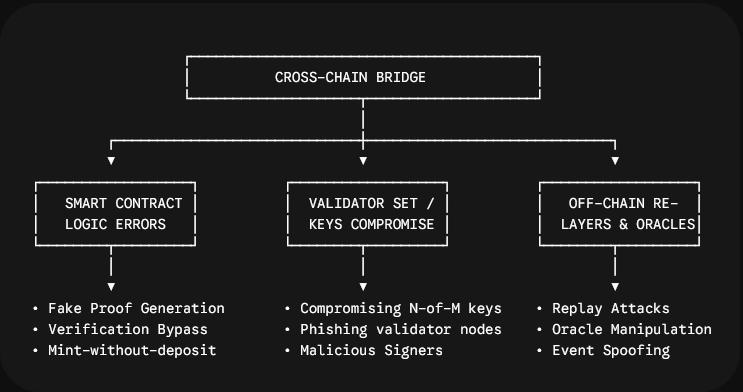
A. Smart Contract Logic & Verification BugsMost trustless bridges operate on a Lock-and-Mint or Burn-and-Redeem mechanism: User locks 100 USDC into a contract on Chain A.A cryptographic proof/event is emitted. The bridge contract on Chain B verifies the proof and mints 100 wrapped-USDC to the user. The Exploit: If the contract on Chain B contains a bug in its signature or proof verification logic, an attacker can forge a deposit message. The target chain’s bridge contract mistakenly believes real funds were deposited on Chain A, minting millions of unbacked wrapped tokens on Chain B, which the attacker then swaps out for hard assets (like ETH or USDT).
Example Case (Wormhole Hack): The attacker exploited a flaw in the bridge's signature-verification system to trick the Solana side of the bridge into believing a deposit was made on Ethereum, allowing them to mint 120,000 wETH out of thin air.
B. Off-Chain Validator & Private Key Compromises
Federated or multi-sig bridges rely on a set of off-chain validators (relayers) to watch Chain A, aggregate signatures, and submit proof to Chain B.
The Exploit: If an attacker compromises enough validator private keys to meet the signing threshold (e.g., getting 5 out of 9 keys in a 5-of-9 multi-sig), they can authorize unauthorized withdrawals directly from the vault.
Example Case (Ronin Bridge Hack): The Axie Infinity Ronin network used a 9-node validator setup. Attackers used targeted social engineering and malware to gain control of 4 Sky Mavis validator keys plus 1 third-party key, meeting the 5-key threshold required to drain over $600M.
C. Replay Attacks & Chain Reorgs
Replay Attacks: If a cross-chain message doesn't contain a unique incrementing nonce or chain-specific identifier, an attacker can take a legitimate withdrawal payload from Chain A and "replay" it multiple times on Chain B, draining funds repeatedly.
Chain Reorgs: If a bridge mints wrapped assets on Chain B too quickly before Chain A’s deposit reaches "finality," an attacker can deposit funds, trigger the bridge mint, and then perform a chain reorganization on Chain A to revert their original deposit.
Building cross-chain infrastructure requires defensive depth that goes far beyond standard smart contract audits.
I. Architectural Isolation & Defense-in-DepthDecouple Modules: Keep deposit tracking, minting logic, and key management separate. A vulnerability in one module shouldn't give total administrative privileges to the entire treasury. Multi-Layer Validation: Never rely solely on an off-chain multi-sig or solely on an on-chain zero-knowledge (ZK) proof. Implement hybrid consensus where both cryptographic proofs and decentralized relayer networks must independently approve high-value transfers.
II. Onchain Rate Limits & Circuit Breakers Bridges should treat every transaction as potentially malicious until proven otherwise. Volume Threshold Caps: Implement strict limits on the dollar value that can leave a bridge within a specific timeframe (e.g., max $2M/hour). Automated Pause / Anomaly Detection: Integrate automated circuit breakers that pause outgoing transactions if withdrawal speeds spike unexpectedly or if a single address requests an abnormal percentage of total value locked (TVL).
III. Hardening Off-Chain Infrastructure Hardware Security Modules (HSMs): Key signers must run inside isolated HSM environments (AWS KMS, GCP KMS, or hardware enclaves) with automated access controls. Geo-Diverse Validator Sets: Ensure validator nodes are distributed across distinct organizations, cloud providers, and physical locations to prevent single-point social engineering attacks.
IV. Delay Windows for High-Value Withdrawals Require a mandatory time-delay (e.g., 6–12 hours) for withdrawals exceeding a specific financial threshold. This gives security teams and automated monitoring bots a window to detect compromised signatures and trigger emergency pauses before assets exit the system permanently.
As a trader or dApp user, navigating cross-chain bridges safely requires active risk management:
Not all bridges are created equal. Before transferring funds, identify the bridge type: Native / Canonical Bridges: Built by the Layer 1/Layer 2 core teams (e.g., Arbitrum One Bridge, Optimism Bridge). These are generally the safest as they share the underlying consensus security of the network. Third-Party Liquid Bridges: Faster, but rely on external validator sets or liquidity pools. Research their validator count, multi-sig threshold, and history.
If you use a non-canonical bridge to bridge ETH to another chain, you receive a wrapped token (e.g., wETH). If the bridge contract holding the native backing ETH gets hacked, your wrapped token can instantly de-peg to zero. Rule of thumb: Swap wrapped assets into the destination chain’s native gas tokens or natively-issued stablecoins (like native USDC) as soon as you complete your bridge transfer.
Utilize public security analytics tools like L2BEAT or DeFiLlama to check bridge security parameters, audit history, and whether the bridge uses upgradable admin keys before moving large volumes.
When bridging tokens, you usually give the bridge contract permission to spend your ERC-20 tokens. Once your transaction completes, use tools like Revoke.cash to clear smart contract approvals so your wallet isn't at risk if the bridge contract is compromised later.
The Path Forward
Cross-chain bridges remain the ultimate test of blockchain engineering. As the multi-chain universe expands, the industry is steadily shifting away from fragile off-chain multi-sigs toward zero-knowledge (ZK) light client bridges and intent-based architectures that drastically minimize the attack surface. Until those technologies fully mature, defensive engineering, strict volume caps, and vigilant user hygiene remain our best lines of defense.