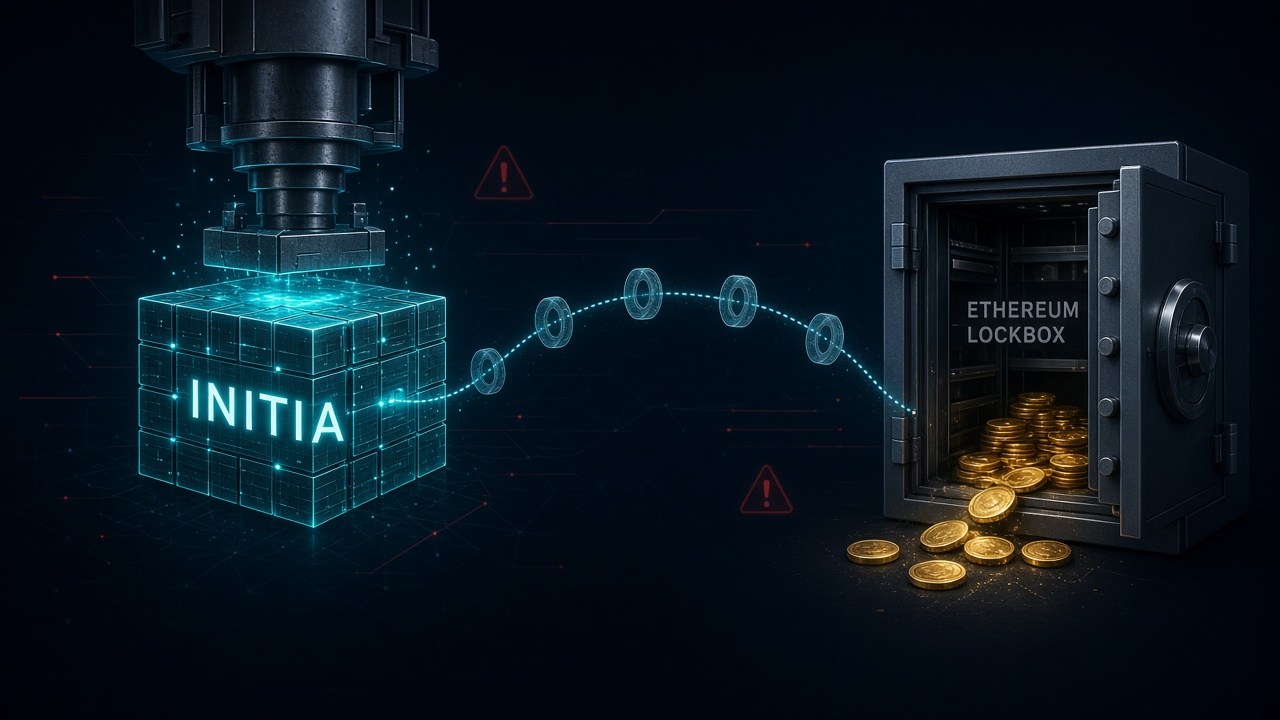
On Friday, October 23, 2026, Initia halted its Layer 1 and all of its rollups after a security incident. Before the halt, an attacker minted bridged tokens on Initia that had nothing behind them, then redeemed them on Ethereum for real assets. The loss is about $2.7M in AUSD, ETH and USDC.
This was not a bridge-contract bug. The bridges on Ethereum did what they were designed to do. That is what makes this incident worth studying.
What happened
Initia co-founder Zon said preliminary findings point to a "Day 0 bug related to Initia's MoveVM on CosmosSDK that allowed the exploiter to mint additional tokens on the Initia L1." He said it "does not apply to native INIT tokens" and that the attacker was "able to mint and bridge out ~$2.7m worth of AUSD, ETH, and USDC before the chain was paused."
On October 24, Initia published its first official findings. The attacker exploited a bug in MoveVM's script caching that let malicious code bypass security checks and spoof VM state, crediting the attacker with unbacked WETH, iUSD and USDC without changing those tokens' recorded total supply. No native INIT was minted. Initia confirmed that about $2.7M was bridged out (105 WETH and ~1.4M AUSD0 via LayerZero, ~1.08M USDC via Noble and CCTP), now held as 1,135.52 ETH in a single Ethereum address. A full post-mortem is still pending. The timeline below comes from on-chain analysis by D2 Finance, as summarised by 0xCERT and Unchained.
Timeline (UTC, Oct 23)
14:59:26. A single transaction on Initia mints unbacked bridged tokens. According to D2 Finance, the attacker called one Move function to mint 2,000,000 units of the Initia-side LayerZero OFT version of AUSD, and the same function was consistent with minting the USDC and ETH representations.
Within 7 min 21 s. About $2.65M has already arrived on Ethereum.
~15:03. The 1.4M AUSD released on Ethereum is swapped through 1inch about 84 seconds after it arrives.
~15:27. Researcher Spreek publicly flags the attack and estimates $2.6M cashed out.
15:41:30. Initia halts the L1 and rollups. In the same minute, the attacker sends about 1,135.5 ETH (~$2.7M) to a fresh wallet.
~16:31. Agora freezes the attacker's Ethereum address. By then it holds no AUSD.
How the money left
Three exit paths were used:
AUSD via a LayerZero OFT adapter. The attacker burned the unbacked Initia-side tokens and sent a LayerZero message to Ethereum. The adapter, a lockbox holding the real tokens, released about 1.4M AUSD. D2 Finance put that at about 71% of the adapter's holdings.
ETH via a native-ETH OFT adapter. The same pattern released 105 ETH, about 96% of that adapter.
USDC via Circle CCTP. About 1.08M USDC was newly minted on Ethereum.
Everything was then swapped to ETH and consolidated.
AUSD's issuer, Agora, has stated that "AUSD does not exist on Initia" and that AUSD is fully backed. The token minted on Initia was a third-party bridged representation. D2 Finance says the AUSD loss falls on the depositors of that third-party adapter, not on AUSD holders in general.
The core lesson: a lockbox trusts the source chain
D2 Finance put it in one line: "an OFT adapter cannot check whether burned tokens were ever backed."
A lock-and-mint bridge has two halves. Real assets sit in a lockbox on the home chain, here Ethereum. A representation is minted on the remote chain, here Initia. When someone burns the representation and sends a valid message, the lockbox pays out.
The lockbox verifies that the message is authentic. It does not and cannot verify that the burned tokens were legitimately minted. If the remote chain's execution layer can be tricked into minting, every message the attacker sends afterwards is "valid".
The consequences:
The weakest chain sets the security of the whole route. A lockbox holding real assets is only as safe as the VM, mint permissions and consensus of every chain it accepts messages from.
Bridge audits are not enough on their own. The LayerZero and CCTP components did not need a bug for this to work. The failure was upstream.
Speed decides the size of the loss. About $2.65M was already on Ethereum before the first public alert. The halt came around 42 minutes after the mint.
What is still unconfirmed
The full technical details of the script-caching bug, and whether other Move-based chains share it
Initia's recovery plan and restart date (Initia expects the fix to be completed and audited "in a few days")
How affected bridged-asset holders and adapter depositors will be treated
As of this writing, the Initia L1 and rollups remain halted while the fix is completed and audited, and the full post-mortem has not been published. Initia says it will post verified updates through its official channels.
If you hold assets on or bridged from Initia
Do not bridge to or from Initia until the team confirms a fix.
Follow only Initia's official channels. Incidents like this attract fake "claim" and "refund" sites.
If you deposited into a third-party bridge adapter, check that adapter's own announcements. Your exposure may differ from that of holders of the underlying asset.
For builders: the first questions to ask
If your protocol runs a lockbox, OFT adapter or similar bridge endpoint, start here:
Which remote chains can trigger releases from this lockbox, and what happens if one of them mints without authorisation?
Is there a rate limit or per-window cap that would have kept a seven-minute drain small?
Who can pause the route, and how fast can they do it outside office hours?
These are only the starting points. The full mitigation checklist, covering supply-invariant checks across chains, rate-limit sizing, circuit-breaker design and an incident runbook for bridge operators, is part of the Advanced Security Academy. Join the waitlist to get it when it opens.
Sources: 0xCERT advisory 0xCERT-2026-0267, The Block, Unchained via Yahoo Finance, Initia incident notice, D2 Finance analysis, Agora statement